


Ryusei Ikebana Exhibition “The Plant Face 2025” Report|A Ryusei-ha Ikebana Artist in Shibuya
Ryusei Ikebana Exhibition “The Plant Face 2025” – On-Site Report
A Ryusei-ha Ikebana Artist’s Perspective on a Contemporary Ikebana & Kado Exhibition in Shibuya

What You’ll Learn in This Article
・Exhibition Overview: “The Plant Face 2025”
・Why Ikebana in Shibuya?
・The Welcoming Arrangement: Beginning the Exhibition
・Themed Installations and Free-Theme Works
・Windows and Suspended Frames
・Workshops and Youth Works
・Large-Scale Works
・Masterworks by the Iemoto
・Classical Ikebana: Rikka and Seika
・About the Author / Ikebana Studio Information
Ikebana and Kado Exhibitions as Places of Practice and Expression
Ikebana and Kado exhibitions are special occasions where artists from each school present the results of their daily training and practice.
Beyond simply arranging flowers beautifully, these exhibitions use entire spaces to reveal the tension, energy, and presence inherent in a single branch, a single flower, or a living plant itself.
This spatial intensity is one of the essential qualities of Ikebana exhibitions.
Even simply viewing an Ikebana work allows the audience to sense the atmosphere of the space and the energy emanating from the arrangement.
This experience cannot be fully conveyed through photographs or videos—it is something that can only be felt by being physically present.
As a Ryusei-ha Ikebana artist, I have participated in and visited many Ikebana and Kado exhibitions over the years.
At the same time, I operate an Ikebana studio in Tokyo, teaching students ranging from complete beginners to those aiming to become certified instructors.

In this article, I document the Ryusei Ikebana Exhibition “The Plant Face 2025”, sharing observations on spatial composition, the use of plant materials, and the relationships between individual works.
This report is written for those who already practice Ikebana as a lifelong art, as well as for beginners who are curious about starting Ikebana or Kado for the first time.
As the author, I also exhibited my own work in this show as a Ryusei-ha Ikebana artist.From this position, I would like to convey the unique structure of the exhibition, the artistic strength of Ryusei-ha Ikebana, and how the theme “The Plant Face” emerged throughout the entire venue.

Exhibition Overview: Ryusei Ikebana Exhibition “The Plant Face 2025”
Ryusei Ikebana Exhibition “The Plant Face 2025”
Dates: November 21 (Fri) – November 24 (Mon, holiday), 2025
First Half: November 21–22
Second Half: November 23–24
Venue: Shibuya Stream Hall, Floors 4–6
Opening Hours: 10:00–18:00
Admission: ¥1,700 (¥1,300 advance), free for high school students and younger
Organizer: Ryusei-ha Iemoto Kasu Yoshimura & Ryusei-ha Headquarters
The Ryusei Ikebana Exhibition is a once-a-year special exhibition open only to instructors of professor rank or above within the Ryusei-ha school.
This particular exhibition holds special significance, as it precedes the 140th anniversary of the Ryusei-ha school, and it carried a strong momentum that conveyed the vitality of Ikebana, Kado, and plant-based expression.

Why Ikebana in Shibuya?
For those encountering Ikebana for the first time, the idea of an Ikebana exhibition in Shibuya may seem unexpected.Ikebana is often associated with quiet contemplation, while Shibuya is known for its constant movement and energy.
However, Shibuya has an important historical connection to Ikebana.
During the late 1950s, at the height of Japan’s avant-garde art movement, Shibuya hosted the legendary Tokyu Ikebana Exhibitions, which remain vividly remembered in the history of Ikebana.
These exhibitions transcended the traditional boundaries of schools and the rigid structure of the iemoto system.Many artists with strong individual identities participated, and the events are still discussed today for their intensity and artistic impact.
Ryusei-ha artists, including former Iemoto Kasen Yoshimura and Takashi Yoshimura, played active roles in these exhibitions.
What unified these historic shows was the overwhelming individual energy radiating from each work, rather than adherence to formal styles alone.

Shibuya as a Living Cultural Landscape
Shibuya has continuously transformed—from a youth culture hub to a center of contemporary culture, business, and technology.
Against this backdrop of constant change, Ryusei-ha has been intentionally positioning Ikebana and Kado as part of Shibuya’s evolving cultural identity.
For the past five years, the Ryusei Ikebana Exhibition has occupied three full floors of Shibuya Stream Hall, presenting Ikebana as a living Japanese art form within the city’s core.
Ryusei-ha places great importance on each artist’s individuality.Even within the same school, no two works share the same sensibility, treatment of materials, or spatial awareness.
Shibuya Stream Hall’s vertical, multi-floor structure provides an ideal setting for experiencing this diversity of energy within a single exhibition.

Shibuya Stream Hall as an Exhibition Space
Shibuya Stream Hall is an event venue directly connected to Shibuya Station.Its defining features include high ceilings, expansive windows overlooking the city, and a vertical layout that allows visitors to move fluidly between floors.
For Ikebana exhibitions, this architecture enables not only horizontal displays but also dynamic use of height, perspective, movement, and the urban landscape itself as part of the exhibition environment.

A Distinctive Ryusei-ha Exhibition Structure
Ryusei-ha exhibitions go beyond simply lining up arrangements.
Alongside large-scale works and mid-sized arrangements, the exhibition incorporates:
Themed installations
Experimental use of non-traditional materials
Workshop spaces
Café and bar areas where visitors can enjoy Ikebana as part of everyday life
This structure presents multiple ways of experiencing plants and Ikebana, emphasizing possibility rather than convention.

The Welcoming Arrangement: Beginning the Exhibition
The exhibition begins on the 4th floor of Shibuya Stream Hall.
At the entrance, visitors are greeted by a welcoming Ikebana arrangement placed in front of a large abstract graphic panel—the official visual motif of “Plant Visions 2025.”
This space also functions as a photo spot, allowing visitors to capture a memory both before and after viewing the exhibition.

The welcoming arrangement was created by Sensei Kasui Chiba.
Using dried areca palm leaves against a green backdrop, the work establishes a strong visual contrast, accented by red autumn berries that trace elegant lines responding to the palm’s dynamic movement.
Notably, the strategic placement of Black Dahlia and Fox Face creates a compelling dialogue between graphic abstraction and the raw presence of living plants.
The result is a powerful opening work that feels simultaneously photographic and deeply organic—an ideal introduction to the exhibition.

Themed Installations and Free-Theme Works
Beyond the entrance, the 4th floor unfolds into a sequence of themed installations and free-theme works.
One of the first areas encountered is the Triangle Stage, where triangular steel frames are treated as vessels for Ikebana.
Here, plants interact with industrial materials, and visitors are invited to view Ikebana from a lowered perspective—an unfamiliar but revealing way of perceiving plant forms, weight, and balance.

Relief Installations and Expanding Free-Theme Works
Moving beyond the Triangle Stage, the exhibition extends deep into the rear of the 4th floor, filling the wall surfaces with works that demand closer observation.
One of the most distinctive sections here is the Relief Installation Area, where Ikebana works are arranged within frames mounted directly onto the walls.
At first glance, these pieces may resemble paintings.However, upon closer inspection, the viewer becomes aware of subtle depth, shadows, and the tension created by plant materials projecting slightly into space.

Branches, leaves, and fruits are composed with careful restraint, allowing the natural thickness, surface texture, and negative space of each material to become part of the visual language.
These works challenge the conventional assumption that Ikebana must exist primarily as a freestanding, three-dimensional form.
Instead, the relief installations propose a new question:How close can Ikebana move toward the plane of painting while still remaining Ikebana?
This experimental approach highlights the sculptural potential of plants and expands the vocabulary of contemporary Ikebana expression.
Free-Theme Works: “The Plant Face” in Their Purest Form
Surrounding the relief installations is a wide-ranging Free-Theme Section, where each artist presents a work shaped entirely by their own perspective.
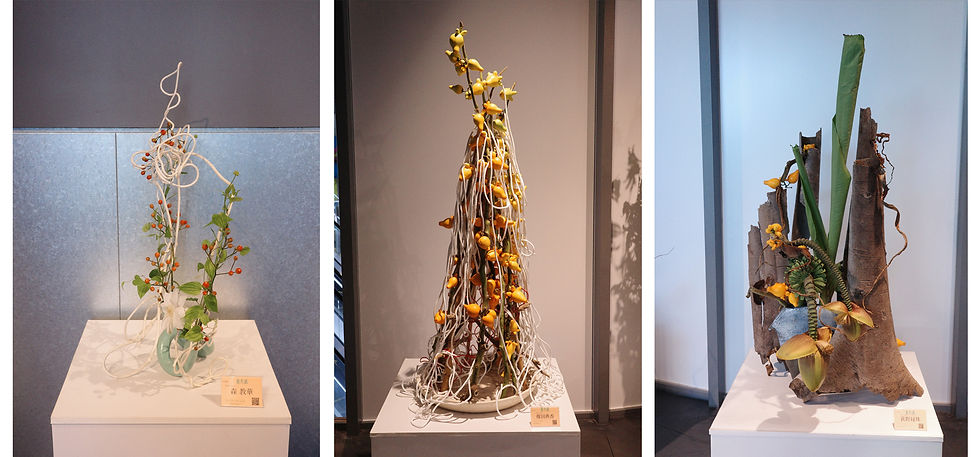
Here, visitors encounter everything from seasonally abundant, classical-feeling Ikebana arrangements to highly personal, experimental plant-based expressions that verge on sculpture or installation art.

The exhibition theme, “Plant Face,” serves as the conceptual foundation for this area.
Within Ryusei-ha, “Plant Face” refers to the practice of discovering and expressing the many faces of plants—their growth patterns, scars, decay, fruits, tension, and vitality—through the individual eye of each Ikebana artist.

(Writer:Demi Kikusuke work)
Because artists independently select their vessels, materials, and compositional strategies, this section reveals an extraordinary diversity of approaches.Each work reflects the artist’s accumulated training, daily discipline, and personal dialogue with plant materials.
For viewers, this becomes a concentrated experience of Ryusei-ha’s defining characteristic:a school that values individuality as a fundamental artistic principle.

Ikebana Without a Vessel: The Red and White Columns
Among the most technically demanding sections on the 4th floor is the installation using tall red and white cylindrical columns, approximately two meters in height.
In this area, artists arrange plant materials directly onto the columns without using traditional vessels.The absence of containers places full responsibility on the artist’s understanding of balance, structure, and material behavior.
Every supporting point, weight distribution, and directional force must be calculated with precision.This is Ikebana reduced to its essentials—plants, gravity, and space—leaving no room for superficial decoration.
The result is a series of works that emphasize both physical control and intuitive sensitivity, underscoring the technical depth that underpins Ryusei-ha Ikebana.

Site-Specific Installations: Windows and Suspended Frames
One of the defining features of Shibuya Stream Hall is its expansive windows, and Ryusei-ha makes full use of this architectural advantage.
In the window-side installations, Ikebana works are placed directly against the backdrop of Shibuya’s cityscape—elevated highways, office towers, commercial signage, and the constant movement of urban life.
Rather than competing with the visual noise of the city, these arrangements enter into dialogue with it.
The plants are neither decorative greenery nor interior landscaping; they are intentional artistic interventions that momentarily synchronize with the surrounding environment.

Similarly, the suspended frame installations introduce a sense of levitation, allowing works to float within the space and alter the viewer’s perception of depth and orientation.
Together, these sections propose a compelling question:What does it mean to arrange plants in the very center of a global metropolis?

5th Floor: Understanding Ryusei-ha’s 140-Year Legacy
Ascending to the 5th floor, the exhibition shifts from visual immersion to historical and educational engagement.
This floor features a comprehensive panel display tracing the 140-year history of the Ryusei-ha school, offering visitors a clear understanding of its origins, philosophical foundations, and evolution into the present day.
For those encountering Ryusei-ha for the first time, these panels provide essential context.
They explain how the school has maintained continuity while consistently redefining Ikebana as a living art form responsive to each era.

Experiencing Ikebana as a Social Space: Café and Bar Area
Behind the exhibition panels, the space opens into a café and bar area, furnished with tables and chairs.
Here, visitors can enjoy light meals, coffee, wine, or other beverages while viewing Ikebana works and conversing with friends or family.
This environment challenges the conventional image of Ikebana exhibitions as silent, formal spaces.Instead, it presents Ikebana as something integrated into everyday life—an art form that can be experienced slowly, socially, and comfortably.

Workshops, Youth Works, and Public Programs
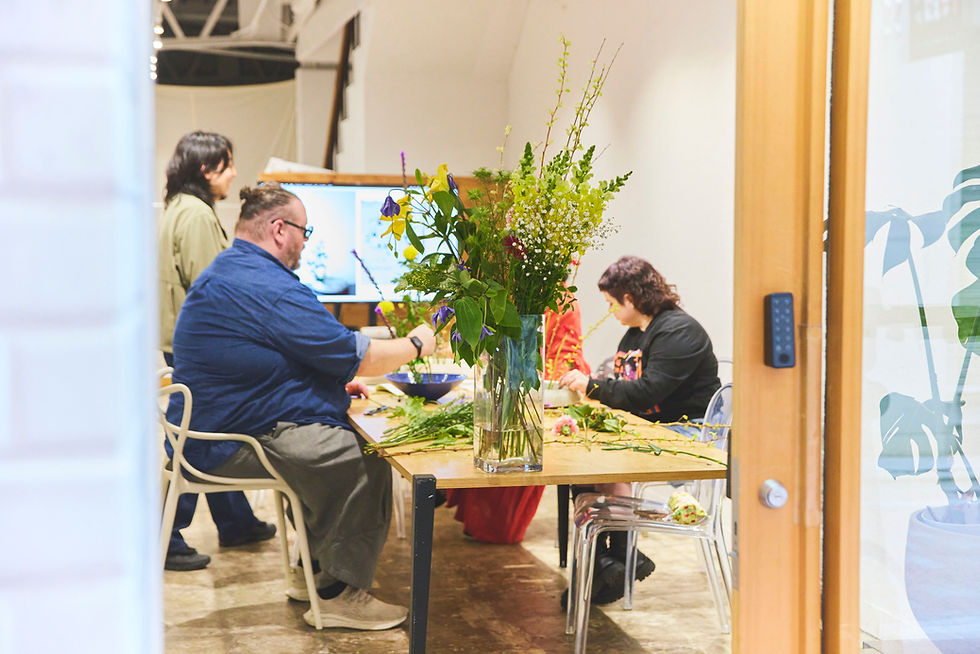
The same floor also hosts Ikebana workshops for beginners, allowing those with no prior experience to engage directly with plant materials and learn the basic principles of Ikebana.
Additionally, works by elementary and junior high school students are displayed, revealing a refreshing and unfiltered approach to plant expression.

These youthful works, often surprisingly confident, stand alongside professional pieces as a reminder of Ikebana’s accessibility and future potential.

At scheduled times, the event space transforms into a lecture venue, featuring talks by the Iemoto and senior Ryusei-ha instructors.
For visitors considering Ikebana or Kado as a long-term practice, this floor serves as an invaluable point of entry.

6th Floor: “Hibika” — A Condensed World of Plant Expression
The exhibition culminates on the 6th floor of Shibuya Stream Hall.
Here, the atmosphere shifts noticeably.The space is dimmed, and visitors are guided into a quiet, contemplative environment that begins with “Hibika,” a distinctive expressive format proposed by the Ryusei-ha school.
“Hibika” is a method in which the scale of an Ikebana work is condensed to approximately one-tenth of its usual size.
Through this radical reduction, subtle aspects of plants—veins in leaves, the layering of petals, emerging buds, minute textures—are brought into sharp focus.
Each work is placed atop an illuminated LED light box, glowing softly from above.This lighting encourages viewers to slow their pace, draw closer, and engage with the plants in an unusually intimate way.

Glass vessels are frequently used in this section, allowing light to refract and reflect through both container and plant material.The result is a delicate, almost jewel-like world where plants, light, and space merge into a single visual experience.
Rather than emphasizing monumentality, “Hibika” reveals that condensation itself can generate intensity, offering another dimension to Ryusei-ha’s understanding of “Plant Face.”

Large-Scale Works and Thematic Sections: The Energy of the Exhibition
Beyond the “Hibika” space, the 6th floor opens into a broad area that gathers the exhibition’s most dynamic works.
This zone includes:
Large-scale Ikebana works
The seasonal “Fruiting” section
The Protrusion Stage
The Island Table installations
Additional free-theme works
Together, these sections represent the peak concentration of energy within the exhibition.

The Fruiting Section: Autumn as Material
By late November, many plants carry fruit, and this seasonal abundance defines the Fruiting Section.
Here, artists use berries, seed pods, and ripened plant forms to explore autumn as both a visual and conceptual theme.
The works convey a sense of maturity, completion, and quiet richness—qualities deeply associated with the Japanese perception of seasonal change.
While distinctly Japanese in sensibility, these arrangements also feel contemporary, demonstrating how traditional seasonal awareness continues to evolve within modern Ikebana practice.

The Protrusion Stage: Ikebana at the Edge of Sculpture
The Protrusion Stage features structures that extend outward from the wall, creating an environment that might initially seem incompatible with Ikebana.

Plants are arranged within these bold, almost athletic frameworks, generating a striking contrast between organic materials and architectural forms.
Despite the unconventional setting, the works remain unmistakably Ikebana.This section powerfully illustrates the breadth of Ikebana as an art form—one capable of engaging with sculptural and installation-based contexts without losing its core identity.

Island Table Installations: Horizontal Expansion
At the Island Table installations, long tables support works that expand horizontally rather than vertically.
Plants appear to flow, crawl, or stretch across the surface, creating compositions that emphasize continuity and movement.In this format, the artist’s intention—what they choose to reveal about the plant—becomes immediately apparent.

These works demand careful consideration of rhythm, spacing, and direction, showcasing the artists’ refined control over both form and negative space.

Masterworks by the Iemoto and Senior Instructors
At the heart of the 6th floor stand monumental works by Iemoto Kashu Yoshimura and leading Ryusei-ha instructors, including Unsen Watanabe and Ryusen Kobuyama.

The Iemoto’s piece occupies a vast area, nearly five meters in scale, and expresses the dynamic energy of autumn plants with remarkable clarity.
Each branch retains its individuality, yet together they form a harmonious whole, enhanced by the subtle transitions of seasonal color.
The work conveys both the elegance of Japan’s four seasons and the authority of a large-scale exhibition held in the center of Tokyo.
As a concluding statement, these masterworks leave a profound and lasting impression.

Classical Ikebana: Rikka and Seika
Up to this point, the exhibition has focused primarily on Free-Style Ikebana (Jiyūka)—works unrestricted by formal rules.
The atmosphere shifts once again in the final section, where Classical Ikebana (Kotenka) is presented.
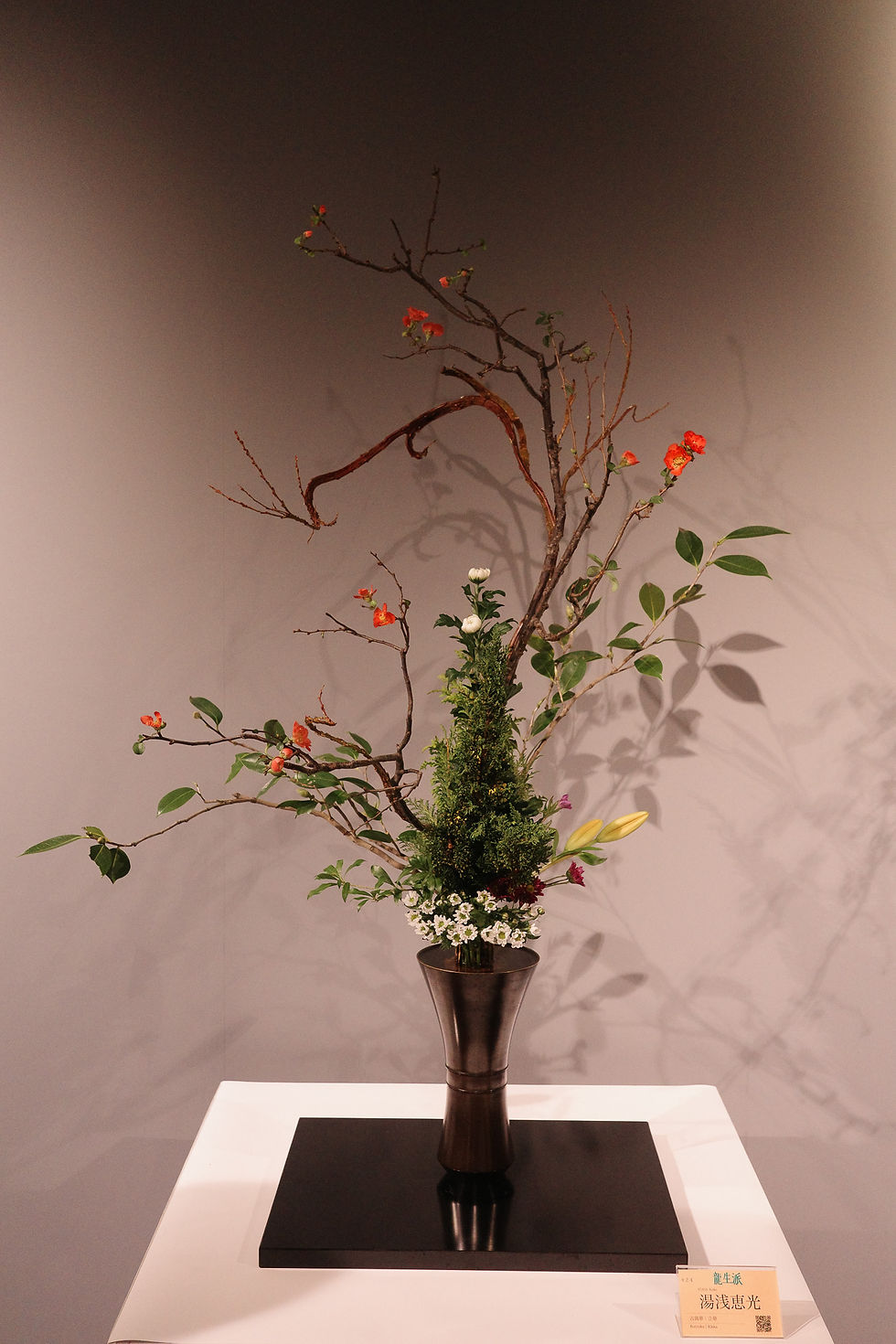
Rikka
Rikka is the oldest form of Ikebana, originating as floral offerings to Buddhist altars.Its history dates back to the Muromachi period in the 14th century.
Today, opportunities to view authentic Rikka are increasingly rare, and only a limited number of practitioners possess the knowledge and skill to create such works.
Within Ryusei-ha, the techniques and philosophy of Rikka have been transmitted orally across generations, preserving this tradition as a living practice rather than a historical artifact.

Seika
Seika emerged during the Edo period as a simplified form of Rikka, suitable for display in the tokonoma alcoves of private homes.
Using primarily branches and a restrained structure, Seika expresses the natural growth and life force of plants.It stands as one of the most refined expressions of Japanese aesthetics within Ikebana.
Ryusei-ha traces its lineage to Ikenobo, the oldest and most influential school of Ikebana, and continues to uphold these classical forms alongside contemporary expression.

A School That Holds Both Tradition and Innovation
Few Ikebana schools maintain a high level of excellence in both contemporary free-style expression and classical forms.
Ryusei-ha’s ability to sustain this dual structure—innovation and tradition in parallel—is one of its defining strengths.
Experiencing both within a single exhibition, in the heart of Tokyo’s Shibuya district, offers a rare and meaningful perspective on Ikebana as a living Japanese art.

Ikebana, Japanese Culture, and the City of Shibuya
In a city that never stops changing,the Ryusei Ikebana Exhibition boldly presents Ikebana, Kado, plants, and flowers as sources of enduring cultural energy.
If this article has conveyed even a fraction of the depth and vitality of Ryusei-ha Ikebana, then it has fulfilled its purpose.
About the Author / Ikebana Studio Information
The author is an active Ryusei-ha Ikebana artist and the founder of IKEBANA STUDIO Oraqua, an Ikebana school based in Tokyo.
The studio welcomes:
Complete beginners seeking a first Ikebana experience
Students wishing to study Ikebana and Kado on a continuous basis
Those aiming to deepen their understanding of Japanese art and plant-based expression
If you are interested in Ikebana, Kado, or studying Japanese flower arrangement in Tokyo,please visit the studio’s website and blog.
▶ Studio Information
▶Ikebana Articles


Comments